GBC Dortmund 2026 Recap: Ittlinger/van de Velde Win the Women's Title at Revierpark Wischlingen
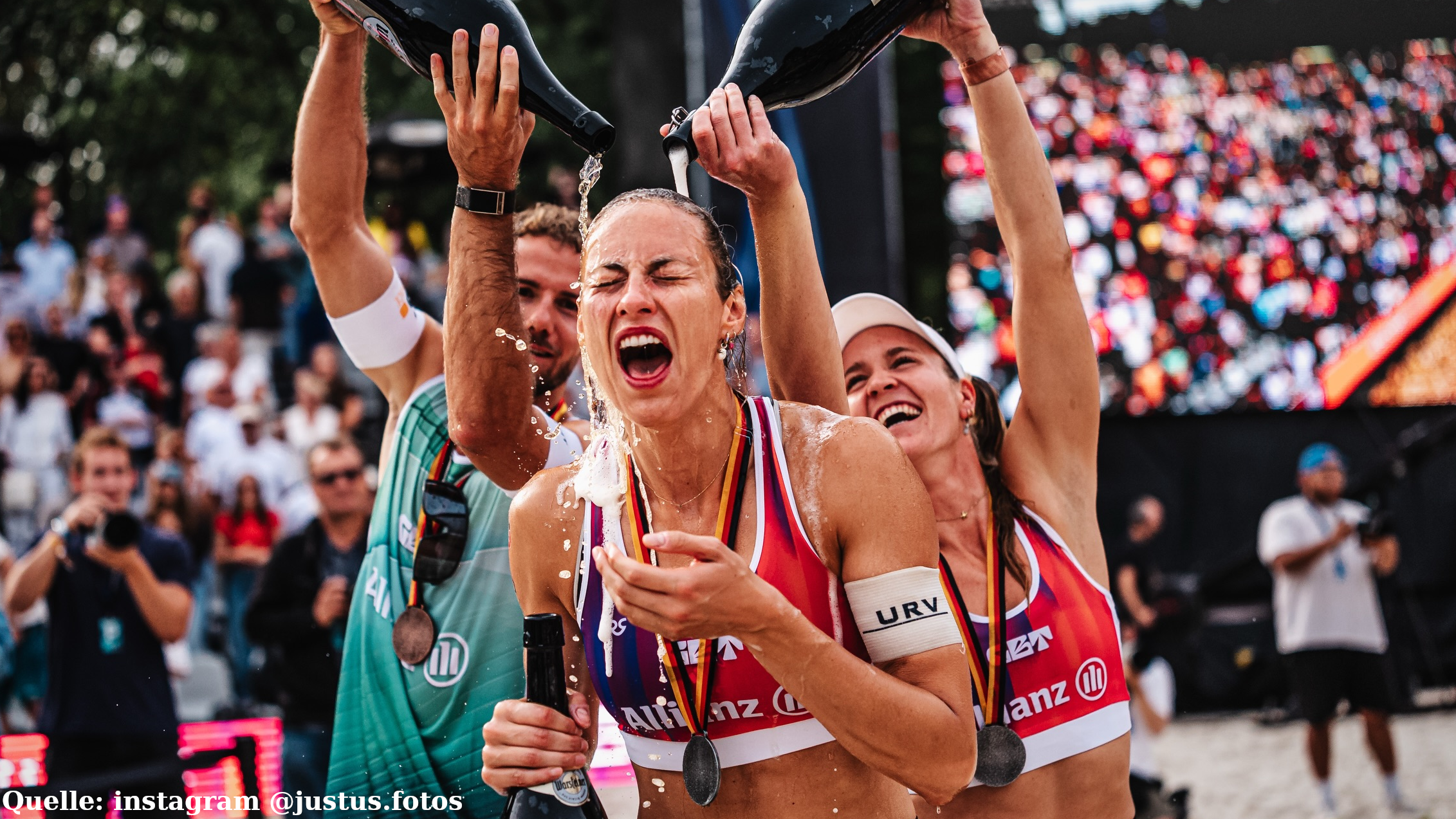
The German Beach Championships (GBC) 2026 — the national championship and the German Beach Tour season finale — were held in Dortmund for the first time from August 27 to 30. Not at Phoenix-See, but at Revierpark Wischlingen. After 33 years in Timmendorfer Strand, that was a cut. On the women's side it was sharper still, because Germany's best pair of recent years was missing: Svenja Müller and Cinja Tillmann had to withdraw through injury. Into that gap stepped Sandra Ittlinger and Kim van de Velde — not in a straight line, but after a loss, a loser-bracket run, and revenge in the final. This is the full recap.
- German champions: Sandra Ittlinger and Kim van de Velde beat Louisa Lippmann and Melanie Paul 21–16, 19–21, 15–12.
- No title defence: Müller/Tillmann withdrew through injury — especially bitter for Dortmund native Müller.
- The crowd: Rain, dance breaks, 6,000 fans doing the Norwegian row, signs, pyro, and soap bubbles.
Bring tie-break tension to the table: get Beachvolleyball – The Cardgame now!
Wischlingen, not Phoenix-See: a championship in a park
The venue change was not a marketing footnote. For 33 years, German beach volleyball's season finale meant the Baltic, the Ahmann-Hager Arena, Timmendorfer Strand. In 2026 the address is Revierpark Wischlingen, Dortmund-West. No lake panorama, no coastal wind — a park, an arena, side courts, and a city that breathes football and still spent four days celebrating sand.
The weather did not spare the premiere. It rained. The sand got heavy, the ball sprayed, cut shots had to leave the hand earlier, line shots needed more conviction. The arena stayed full anyway. About 6,000 on finals day, capacity a little above that. Anyone who thought rain would send Ruhr fans home had not counted on dance breaks, walls of signs, pyrotechnics, and soap bubbles — or on the moment the whole arena locked into the Norwegian row. One movement, 6,000 people, one beat. That is the kind of noise that carries a match before the first serve.
For the women's matches that backdrop was gold. Longer rallies, more ball control, more situations where a loud side-out makes the next serve harder. Wischlingen delivered it, wet and loud. Our GBC Dortmund 2026 men's recap is set in the same arena with a different script: a clean favourite win there, a revenge thriller here.
The withdrawal that changed everything: Müller/Tillmann out
Svenja Müller and Cinja Tillmann were the measure of the last few years. Four straight titles through 2025, Germany's best pair, the duo you had to beat if you wanted to know whether you were ready for gold. In 2026 they could not defend. Both withdrew through injury. That is not a side note. It is a hole in the seeding sheet and in the story of the tournament.
For Müller it cuts deeper than for almost anyone else. She is from Dortmund. A German championship in her city, in the Revierpark, in front of a crowd treating beach volleyball as a big event for the first time — and she cannot play. Tillmann misses the shot at a fifth title in a row. The field loses the pair everyone else would have measured themselves against. What remains is an open tournament in which the No. 1 seed can still have to go through the loser bracket before gold is possible.
That is exactly what happened to Ittlinger and van de Velde. They succeeded Müller/Tillmann, but not by walking through the draw from the top. They lost, came back, and took revenge in the final. That is a different kind of championship from an unbeaten week. It fits a year in which the defending champions are missing and every pair has to renegotiate who sits at the top.
Rain, signs, rowing: the atmosphere that carried the week
You can measure a beach tournament by the scores. You can measure it by the volume. In Wischlingen the two belonged together. Despite the rain the atmosphere was electric. Fans danced between sets and sometimes in the middle of them. The signs were so dense that center court sometimes looked like a handball derby. Pyrotechnics recolored the drizzle in seconds. Soap bubbles are a bad idea in this weather, which is why they were the right one.
The Norwegian row with 6,000 people is the image that sticks. Not because it is original — football grounds know it. Because it happened in a park in Dortmund, at a German beach volleyball championship, after 33 years on the Baltic. It says this sport is allowed to be loud. It is allowed pyro. It is allowed signs. It does not have to wait for the sun to take the marketing photo.
For the players that is pressure and tailwind at once. A tie-break in front of a rowing arena is a different match from a tie-break in front of polite applause. Ittlinger and van de Velde held that in the final. So did Lippmann and Paul — they took the second set when the crowd already wanted gold for the No. 1 seed. If you love those moments, you know the same kick from the sofa or the game table. That is why our look at the top 5 board games for sports fans sits here as kinship, not as a detour.
The path to the title: a loss, the loser bracket, revenge
Sixteen pairs, double elimination. Ittlinger/van de Velde started as the No. 1 seed. Camp/Kaminski and Barber/Gernert went down in the winners' bracket. Then came Louisa Lippmann and Melanie Paul — a pair that has only been together a short time, trains in Hamburg, and is tactically awkward because there is no finished scouting template yet. Lippmann/Paul won the third round of the winners' bracket. The favourite champions were in the loser tree.
From there the classic, unforgiving walk back: Behlen/Schulz, Maidhof/Schwarz, then the semi-final against Anna-Lena Grüne and Janne Uhl. Two sets, into the final. Grüne/Uhl were the No. 3 seeds and had run their own winners' show, including a win over Bock/Kunst. Fourth place after a semi-final against the eventual champions is harsh and sportingly honest. Bronze went to Nele Barber and Melanie Gernert, who had lost to Lippmann/Paul in the semis and had the better answer in the bronze match.
Barber/Gernert are the constant of this summer. They do not win every final, but on the days that matter they are hard to kill: long rallies, veteran poise, no respect for the seeding sheet. Bronze in Dortmund after a season in which they already won Tour titles underlines that. Bock/Kunst, the No. 2 seed, finished fifth, Behlen/Schulz alongside them: the field behind the finalists was tight enough that any quarter-final could have flipped.
Lippmann/Paul wrote the tournament from the other side. Winners' bracket into the semi-final, a win over Barber/Gernert, the final. For a young partnership (in the sense of the pairing, not age) that is a statement. Melanie Paul knows big finals; Louisa Lippmann brings indoor volleyball DNA. Together they had already beaten Ittlinger/van de Velde — two rounds before the final. Taking the second set in the gold match and then losing the tie-break is not an accident. It is the gap between “we can beat them” and “we beat them when gold is on the line.”
The final: 21–16, 19–21, 15–12 — revenge in three sets
The women's final was the dramatic opposite of the men's. Where Ehlers/Wüst marched through in two clear sets, Ittlinger and van de Velde needed the tie-break. First set 21–16, second set 19–21, third set 15–12. Revenge for the loss two rounds earlier. For Sandra Ittlinger, 32, from Munich, a second national title after 2020. For Kim van de Velde, 34, born in Bremen, a first.
The second set is where the match could have flipped. Lippmann/Paul took it, the arena switched, and the tie-break stopped being a formality. 15–12 is not a blowout. It is the point gap in which passing, blocking, and one extra risk decide it. Ittlinger/van de Velde played those points colder. Not prettier. Colder.
That is the core of this championship: the favourites were not untouchable, they were correctable. They lost, found the way back through the park, and put a better version of themselves on the court in the third set. If you want to replace Müller/Tillmann, you cannot do it with a clean weekend. You have to show you still want gold after you have been hit. Ittlinger and van de Velde did that in Wischlingen.

In the photo: Beachvolleyball – The Cardgame. The same timeout decisions as in the women's final — packed into a card game that sits next to the court.
GBC 2026 women's placements
Official main-draw results from the German Volleyball Federation (DVV women's results):
| Place | Team | Club |
|---|---|---|
| 1 | Sandra Ittlinger / Kim van de Velde | Eintracht Spontent / Blaubären TSV Flacht |
| 2 | Louisa Lippmann / Melanie Paul | BR Volleys / Eintracht Spontent |
| 3 | Nele Barber / Melanie Gernert | SV Energie Cottbus |
| 4 | Anna-Lena Grüne / Janne Uhl | Helios GRIZZLYS / Eintracht Spontent |
| 5 | Anna Behlen / Sarah Schulz | 1. Beachclub Kiel |
| 5 | Linda Bock / Lea Sophie Kunst | Schweriner SC / Eintracht Spontent |
| 7 | Elea Beutel / Paula Schürholz | SC Potsdam / Eintracht Spontent |
| 7 | Rika Dieckmann / Clara Dreßen | Eintracht Spontent Düsseldorf / VCO Münster |
| 9 | Chenoa Christ / Sophia Neuß | TUS Kriftel / Eintracht Spontent |
| 9 | Emma Gangey / Louisa Marunde | Hauptstadt Beacher |
| 9 | Mila Jancar / Josefine Schäkel | Eintracht Spontent Düsseldorf / 1. Beachclub Kiel |
| 9 | Mareet Maidhof / Tabea Schwarz | VCO Münster / BeachVolley United |
| 13 | Geeske Camp / Ida Kaminski | FC St. Pauli / Beachvolley United |
| 13 | Nina Interwies / Nele Schmitt | Beach me / DJK TUSA 06 Düsseldorf |
| 13 | Leonie Klinke / Anna-Chiara Reformat | Beachverein Heidelberg / Marzahner VC |
| 13 | Sandra Otte / Annalena Richter | TV Lenggries / VSG Ettlingen Rüppurr |
The seeding only half held. No. 1 becomes champion, No. 2 (Bock/Kunst) finishes fifth, No. 3 (Grüne/Uhl) fourth. Lippmann/Paul arrived as the No. 4 points pair and leave with silver. Barber/Gernert, eighth on the sheet, take bronze. That is a field in which weekend form beats the August ranking. That is why the whole list matters, not just the podium.
What the rain did to the women's game
On the women's side, wet sand changes the match even more visibly, because rallies last longer and ball control counts more. A cut that is a winner on dry sand often dies in the rain. A line shot needs more height and more conviction. Passing becomes the currency: clean first ball and you can attack; miss it and you gift the break. Ittlinger/van de Velde won the tie-break that way — not with the flashiest ball, but with the colder one.
Lippmann/Paul showed in the second set that they stay dangerous in exactly those conditions. A pair without a long shared scouting map can even have an edge in the rain, because both are already playing on sight. The third set then showed where the seeded experience sits: less extra risk, a clearer block line, less debate after the error. 15–12 is the point gap in which weather stops being an excuse and is only a court.
Behind the final sat the same 16-team field that makes a championship a championship. Beutel/Schürholz and Dieckmann/Dreßen in seventh, Christ/Neuß, Gangey/Marunde, Jancar/Schäkel and Maidhof/Schwarz in ninth: those are not archive-page stats. They are the matches that filled the arena on Friday and Saturday before gold took the photos on Sunday. Barber/Gernert took bronze out of that middle of the draw. Grüne/Uhl, the No. 3 seeds, reached the semi-final and lost to the eventual champions. Without Müller/Tillmann, every one of those matches was potentially a fight over the new hierarchy.
What the women's tournament showed tactically
First: an early loss in double elimination is not a funeral if the pair serves harder afterwards, not softer. Ittlinger/van de Velde did not hunt the safe ball after losing to Lippmann/Paul; they sharpened the plan. Second: new partnerships can beat seeded pairs before the scouting map is finished. Lippmann/Paul proved that in the winners' bracket. Third: without Müller/Tillmann the top gets wider and gold gets heavier, because nobody has the one match that means “against the best.” Every semi-final is suddenly a potential final.
The same logic — risk on match point, reading the block line, not changing character after a lost set — sits inside Beachvolleyball – The Cardgame. A recap cannot replace the rallies. A card game can replace the decision that comes after the timeout. If Wischlingen has left sand in your head, pack the game in the same bag as the packing list for your beach volleyball camp or give it to the partner you are planning next season with — gift ideas for beach volleyball players.
The GBC 2026 women's tournament was a championship of gaps: without Müller/Tillmann, without sun, without Phoenix-See. Instead: Wischlingen, rain, rowing, revenge. Ittlinger and van de Velde deserved gold because they put a better version on the court after the loss. The arena paid them back, wet and loud. In 2027 Dortmund will not be asked whether the premiere worked. It will be asked whether Müller/Tillmann are back — and whether Ittlinger/van de Velde then defend the title instead of taking the long way to win it.
Bring tie-break tension to the table: get Beachvolleyball – The Cardgame now!
Disclaimer: This article was created with the help of artificial intelligence (AI) and reviewed and optimized by our editorial team.


